
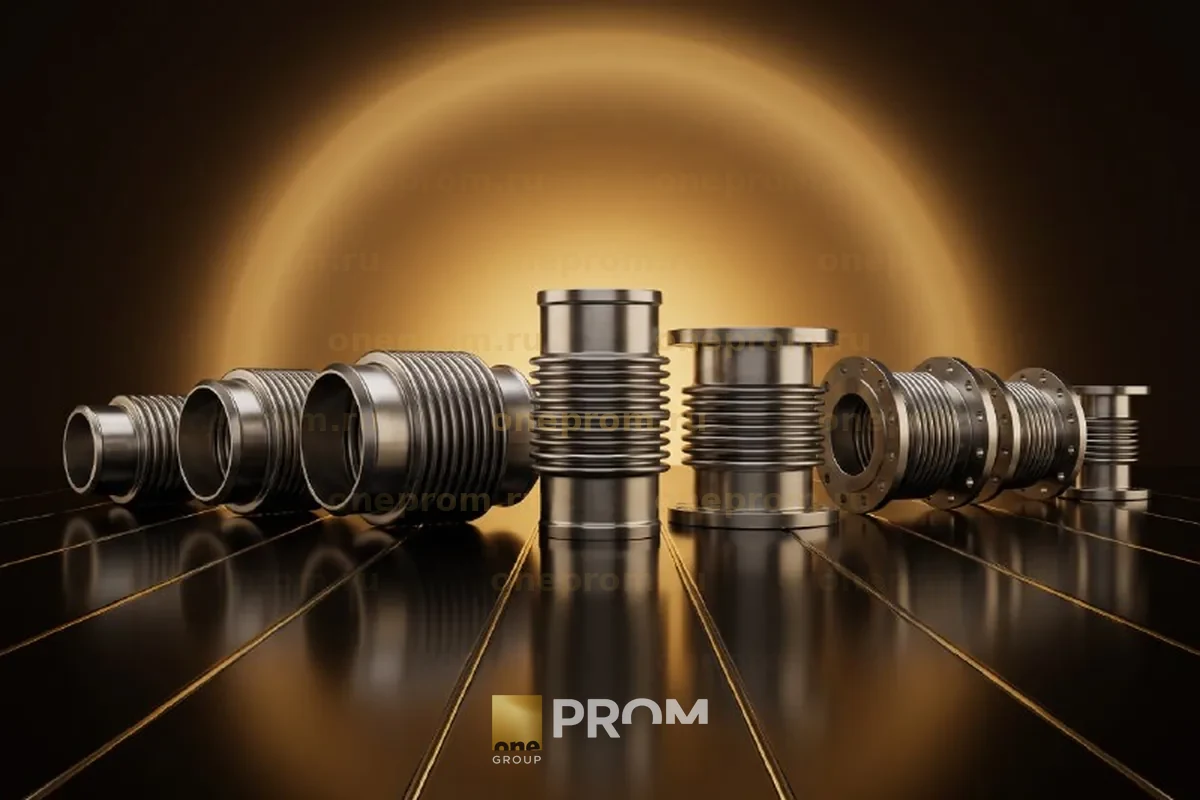
1. Joint type
The type depends on the movement that has to be absorbed.
| Type | What it absorbs | Where it is used |
|---|---|---|
| Axial | Compression and extension along the pipe axis | Straight sections of heating networks and process pipelines |
| Lateral | Offset of the ends across the axis | Sections next to equipment, routing around obstacles |
| Angular | Rotation by a small angle | Spatial systems of several angular joints |
| Universal | Combined axial and lateral movement | Complex routes with movement in several directions |
The most common is the axial joint: it is installed in-line between two anchors.

2. Diameter and pressure
Nominal diameter DN equals the pipeline diameter. Nominal pressure PN must be no lower than the maximum operating pressure, including hydrotesting: the joint must withstand the system test pressure.
The higher the pressure, the greater the thrust on the anchors. For large DN and PN, pressure-balanced joints are considered — they do not transfer this force to the anchors.
3. Movement capacity
Movement is the key parameter. It is calculated for each section between anchors: expansion when heated plus contraction when cooled below installation temperature. You can calculate it in our expansion calculator.
The joint is selected with a movement capacity no less than the calculated movement, with a margin. Excessive movement is the number one cause of failure.
4. Temperature and medium
They determine the bellows material. For water, steam and most neutral media, stainless steels such as AISI 321 (12Kh18N10T) are used. For chloride-containing and aggressive media — more resistant grades, for example AISI 316L, or special alloys.
The minimum temperature also matters: for outdoor pipelines in the North, material and design are selected for frosts down to −60 °C.
5. End connection
Weld ends are more reliable and cheaper, suitable for most heating networks. Flanged — when quick removal is needed or the pipeline is already flanged. Flanges are matched to the pipeline counterpart standard: type, pressure, sealing face.
6. Additional elements
- Protective cover — against mechanical damage and insulation getting onto the bellows;
- Internal liner — at high flow velocity, to reduce vibration and convolution wear;
- Limit rods — to prevent the joint from overextending.
7. Cycle life
Life is specified as the number of heat-up and cool-down cycles. Heating networks with one heating season a year see few cycles, while process pipelines with frequent starts and stops need the cycle life stated explicitly — it affects the bellows design.
What to send for selection
For accurate selection the first time, send us:
- The type or section layout: where the anchors are, what movements occur.
- DN and operating pressure, hydrotest pressure.
- Calculated movement, or section length and temperatures: installation, operating, minimum.
- The medium and its maximum temperature.
- End connection: weld ends or flanges, flange standard.
- Whether a cover, liner or limit rods are needed.
- Quantity and delivery time.
Send us the parameters — we will select the joint and calculate the anchors.
Expansion joints catalogueFAQ
What movement margin should be allowed?
Can a joint with a larger DN than the pipe be installed?
Which is more reliable — weld ends or flanges?
Is a protective cover needed in a heating network?
Can a joint be selected without a movement calculation?
Read next
How to Calculate Thermal Expansion of a Pipeline
The ΔL = α·L·Δt formula, coefficients for different materials, a worked example and an online calculator for expansion joint movement.
Reading time: 6 min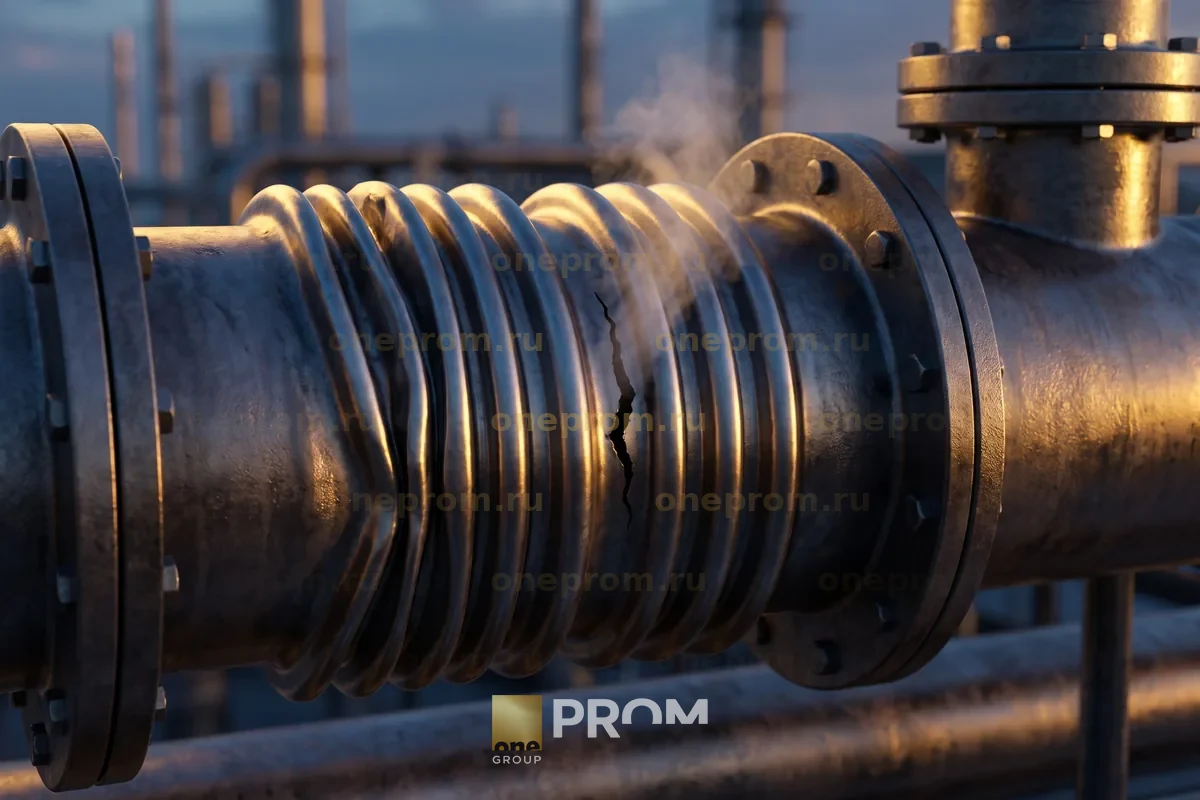
Why Bellows Fail: 8 Causes of Expansion Joint Failure
Excessive movement, torsion, supports, corrosion, vibration and installation errors — plus a checklist to avoid them.
Reading time: 7 min
Variable Frequency Drive on a Pump: How Much It Saves
Why power drops with the cube of speed, a worked example and a savings and payback calculator.
Reading time: 6 min