
In short
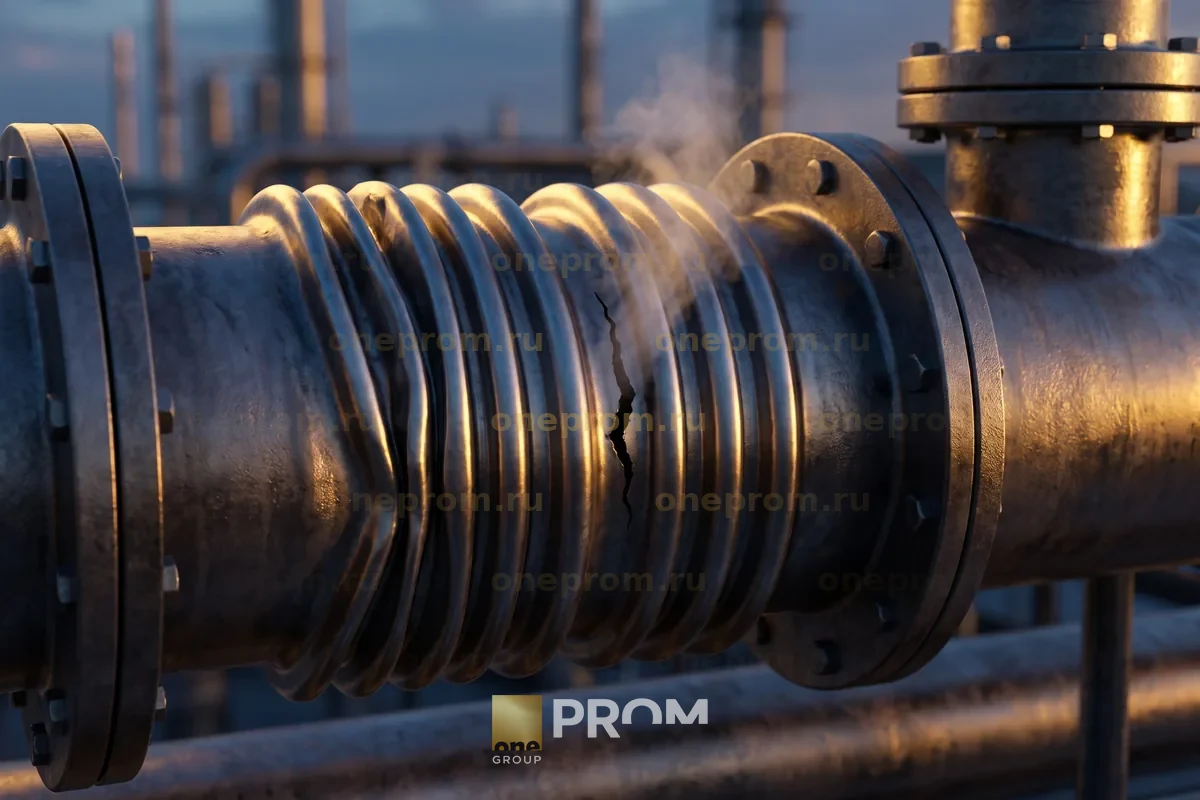
A bellows is a thin corrugated stainless steel shell. It is designed for a specific movement, pressure and number of cycles, and works reliably only within these limits. Most failures are not about the quality of the bellows itself, but about forcing it to work outside its design conditions.
| Cause | Where the error is |
|---|---|
| Excessive movement | Calculation |
| No guides | Design, installation |
| Torsion | Installation |
| Shipping bars | Installation, start-up |
| Weak anchors | Design |
| Corrosion | Operation, material choice |
| Vibration and water hammer | Operation |
| Installation damage | Installation |
1. Movement exceeds the design value
The joint was selected for heating but cooling below installation temperature was not considered, or the section length was wrong. The bellows compresses or extends more than designed, and the convolutions deform plastically.
How to spot it: uneven convolutions: some fully compressed, some stretched; cracks along the convolution crests.
How to prevent it: calculate the total movement — expansion when heated plus contraction when cooled — and select the joint with a margin. You can do this in our expansion calculator.
2. No guides or guides placed too far
Under pressure, the bellows tends to bow sideways — like a spring compressed without a guide. If the pipe is not kept on its axis, the joint loses stability and bends into an arc.
How to spot it: the joint is visibly bent, convolutions compressed on one side and open on the other.
How to prevent it: install guides on both sides of the joint. According to EJMA — the first no further than 4 pipe diameters, the second no further than 14 diameters.
3. Torsion during installation
An axial joint is not designed for twisting. If one end was rotated relative to the other during installation to align flange holes or fit a joint, stresses appear in the convolutions that do not relax in service.
How to spot it: convolutions run in a spiral, a visible twist.
How to prevent it: align flange holes by rotating the mating flange on the pipe, not the joint; never use the joint to fit misaligned pipes.
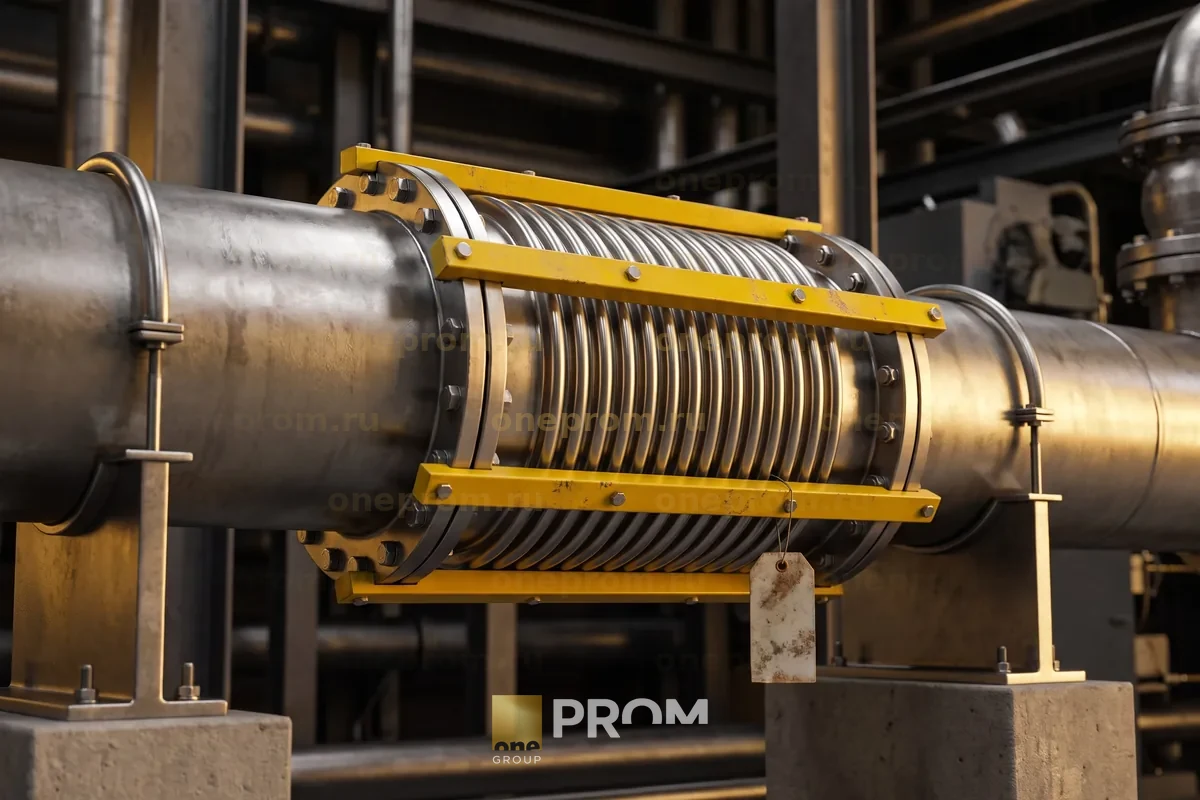
4. Shipping bars not removed or removed too early
Shipping bars hold the joint at its factory length. If they are left on, the joint does not work and the expansion goes into anchors and welds. If removed before the supports are fixed, the joint gets stretched or compressed during installation.
How to spot it: bars still in place after start-up; or the joint is installed noticeably longer or shorter than its factory length.
How to prevent it: remove the bars strictly after all supports are fixed and before filling the system; record the removal in the installation report.
5. Anchors cannot take the load
Pressure inside the bellows creates a thrust force that tends to push the pipes apart. This force is taken by the anchors. If an anchor is under-designed, it shifts, and the joint is stretched beyond its design.
How to spot it: a shifted or deformed anchor, an overstretched joint.
How to prevent it: design anchors for the pressure thrust plus the joint stiffness; for large diameters and pressures consider pressure-balanced joints.
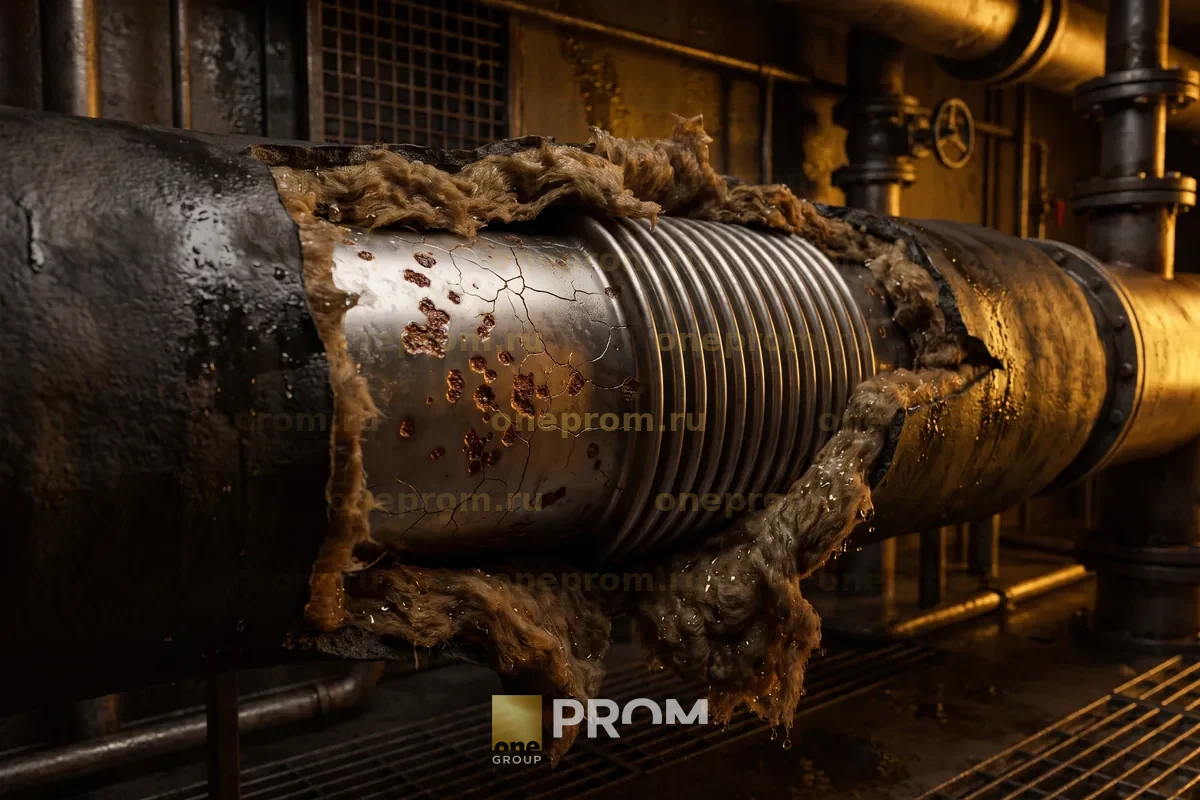
6. Corrosion
The thin bellows wall is sensitive to corrosion. The most common case is wet thermal insulation: moisture leaches chlorides from it, causing stress corrosion cracking of stainless steel. The second case is a bellows material unsuitable for the medium.
How to spot it: pitting, a network of fine cracks, stains under the insulation.
How to prevent it: protect insulation from moisture, use jackets; select the bellows steel grade for the medium and temperature.
7. Vibration and water hammer
A bellows is designed for a certain number of cycles. Vibration from pumps and water hammer from sudden valve opening and closing add thousands of extra cycles and quickly exhaust its life.
How to spot it: fatigue cracks in the convolution roots without visible deformation.
How to prevent it: soft start of pumps and slow valve closing; variable frequency drives and anti-vibration joints on pumps.
8. Damage during installation
Weld spatter on the convolutions, a tool strike, welding current passing through the bellows — each such defect becomes a crack initiation point.
How to spot it: dents, burn marks, metal droplets on the convolutions.
How to prevent it: cover the bellows with a protective shield during welding, connect the welding ground so that current does not pass through the joint, never use the joint as a support or a step.
We will select an expansion joint for your movement, pressure and medium — with anchor calculation.
Expansion joints catalogueInstallation checklist
- Check that the joint matches the design: type, movement, pressure, connection.
- Make sure anchors and guides are installed according to the design.
- Install at factory length, without torsion, aligned with the pipeline.
- During welding, shield the bellows and do not let welding current pass through it.
- Fix all supports.
- Remove the shipping bars and record it in the report.
- Fill and heat the system smoothly, without water hammer.
FAQ
Can a cracked bellows be repaired?
When should shipping bars be removed?
How long does a bellows expansion joint last?
Why must a bellows not be twisted during installation?
Why is wet insulation dangerous?
Read next

How to Calculate Thermal Expansion of a Pipeline
The ΔL = α·L·Δt formula, coefficients for different materials, a worked example and an online calculator for expansion joint movement.
Reading time: 6 min
Variable Frequency Drive on a Pump: How Much It Saves
Why power drops with the cube of speed, a worked example and a savings and payback calculator.
Reading time: 6 min