
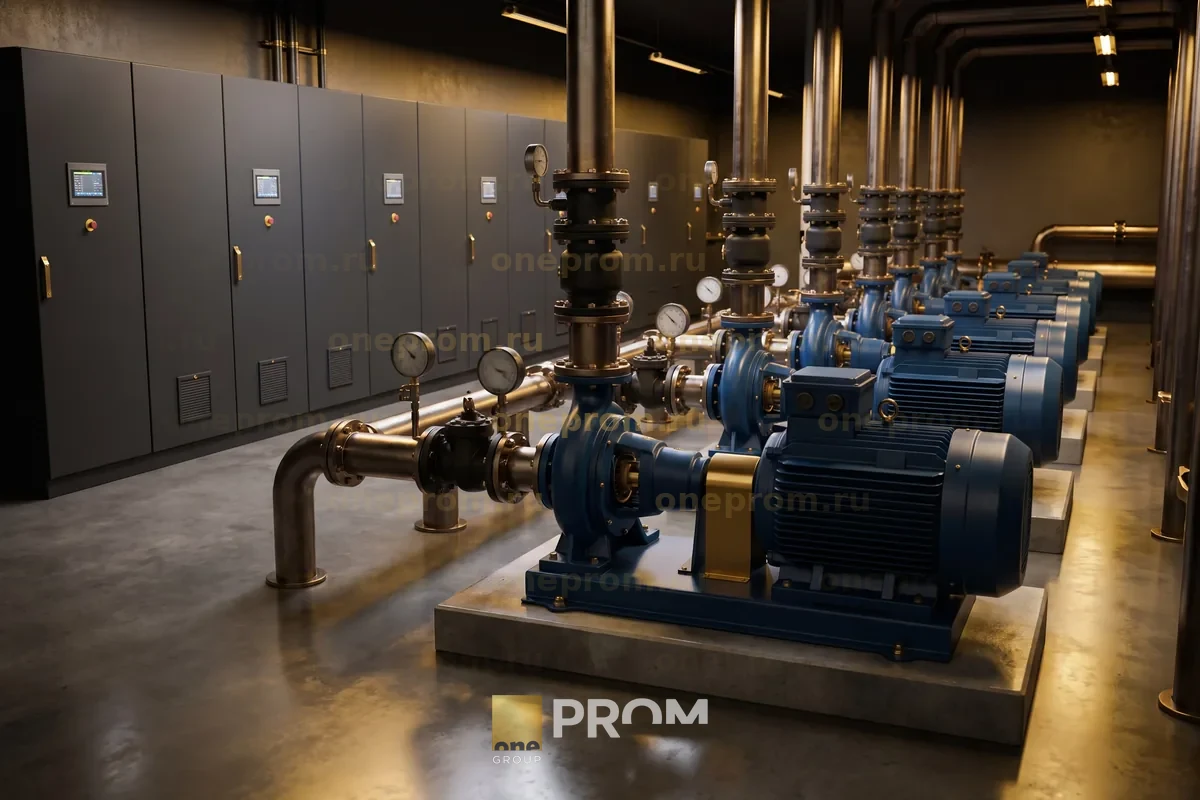
How a VFD saves energy
Without a drive, the pump always runs at full speed. To reduce flow, a valve is throttled: the pump keeps running at almost full power, and the excess energy is lost in throttling.
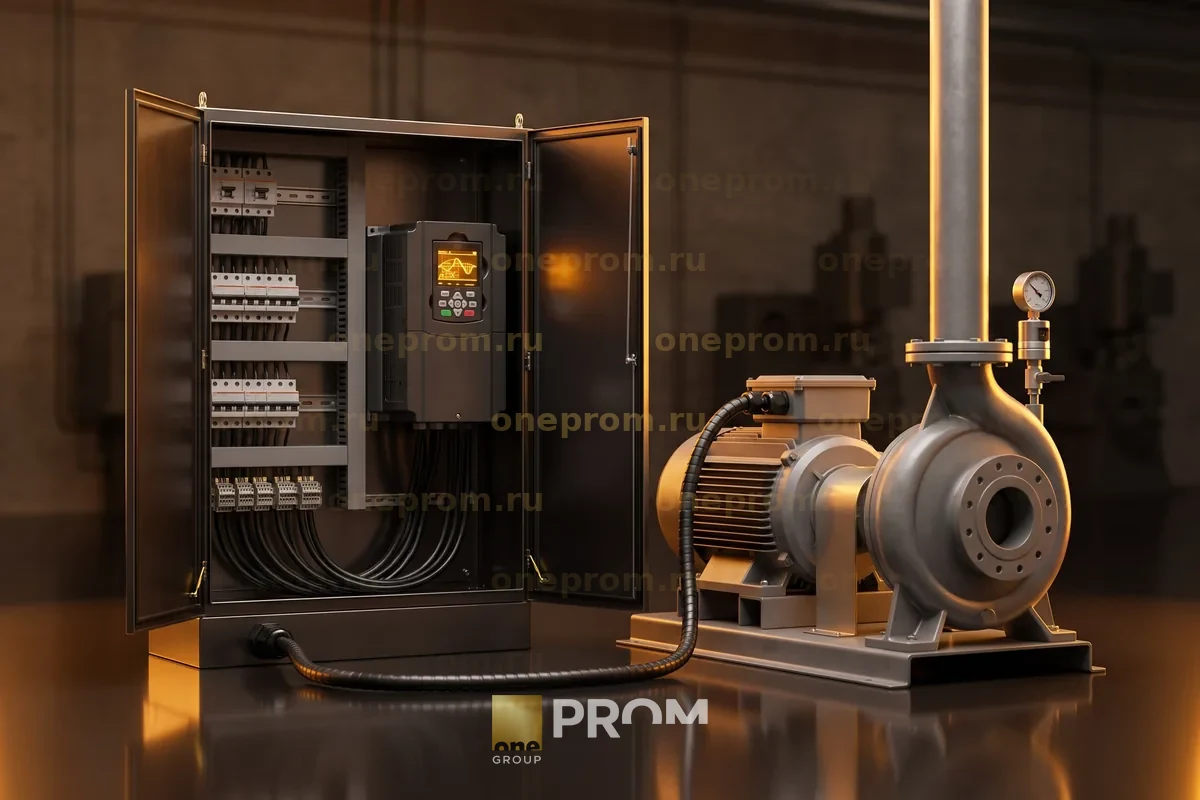
A variable frequency drive changes the motor supply frequency and reduces its speed. The pump delivers exactly the flow needed and consumes much less.
Affinity laws
For centrifugal pumps and fans, the affinity laws apply when the speed n changes:
- Q — flow changes in proportion to speed;
- H — head changes with the square of speed;
- P — power consumption changes with the cube of speed.
Hence the main effect: reduce speed by 20% — and power drops almost by half.
Power at reduced speed
| Speed | Flow | Head | Power |
|---|---|---|---|
| 100% | 100% | 100% | 100.0% |
| 90% | 90% | 81% | 72.9% |
| 80% | 80% | 64% | 51.2% |
| 70% | 70% | 49% | 34.3% |
| 60% | 60% | 36% | 21.6% |
| 50% | 50% | 25% | 12.5% |
Theoretical values from the affinity laws, excluding static head and drive losses.
Worked example
A pump with a 55 kW motor runs 6,000 hours a year. Flow is controlled by a valve, and on average about 80% of rated flow is needed. With throttling, the pump consumes about 90% of rated power.
- Without a drive: 55 × 0.9 × 6,000 = 297,000 kWh a year.
- With a drive: power at 80% speed — 55 × 0.8³ = 28.2 kW; with about 3% drive losses — 29 kW. Per year: 29 × 6,000 ≈ 174,000 kWh.
- Savings: about 123,000 kWh a year — at $0.10 per kWh that is roughly $12,300.
The tariff and mode in the example are illustrative — enter your own values in the calculator below.
Savings calculator
Estimate based on the affinity laws including about 3% drive losses. Static head reduces savings — a OnePROM engineer will calculate your pump station precisely.
Select a variable frequency driveWhen a VFD does not pay off
- The pump always runs at rated duty. If flow does not change and the valve is fully open, there is no room to reduce speed.
- High static head. If the pump lifts water to a height or works against constant pressure, speed can be reduced only slightly.
- The pump runs little. With a few hundred hours a year, savings will not cover the drive cost.
Other benefits
- Soft start and stop — without current surges and water hammer. Water hammer is one of the reasons why bellows fail.
- Less wear on the pump, bearings, seals and valves.
- Precise control of pressure or flow by a sensor — without manual valve adjustment.
We will select a variable frequency drive for your pump and duty.
Variable frequency drives catalogueFAQ
How much does a variable frequency drive really save?
Why are savings lower than the cube law suggests?
What else does a VFD provide besides savings?
Can a VFD be installed on any motor?
How to size a variable frequency drive?
Read next

How to Calculate Thermal Expansion of a Pipeline
The ΔL = α·L·Δt formula, coefficients for different materials, a worked example and an online calculator for expansion joint movement.
Reading time: 6 min
Why Bellows Fail: 8 Causes of Expansion Joint Failure
Excessive movement, torsion, supports, corrosion, vibration and installation errors — plus a checklist to avoid them.
Reading time: 7 min