
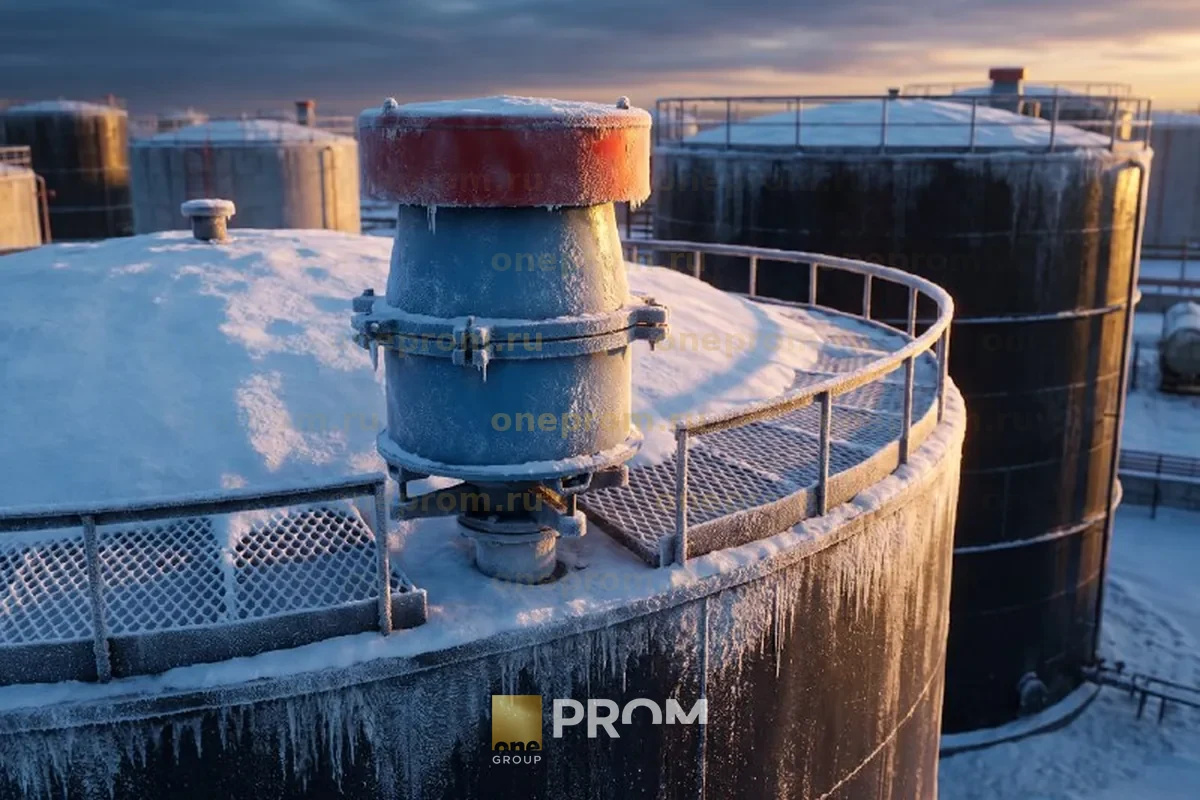
Why a tank breathes
Above the product inside the tank is a vapour space. Its pressure changes constantly:
- Working breathing — during filling, the product pushes vapours out; during emptying, air must be let in;
- Thermal breathing — during the day the vapour heats up and expands, at night it cools and contracts.
The shell and roof of a vertical tank are designed for very low pressures. If the vapour cannot escape, the roof can be torn off; if air cannot get in, vacuum collapses the shell.
How the valve works
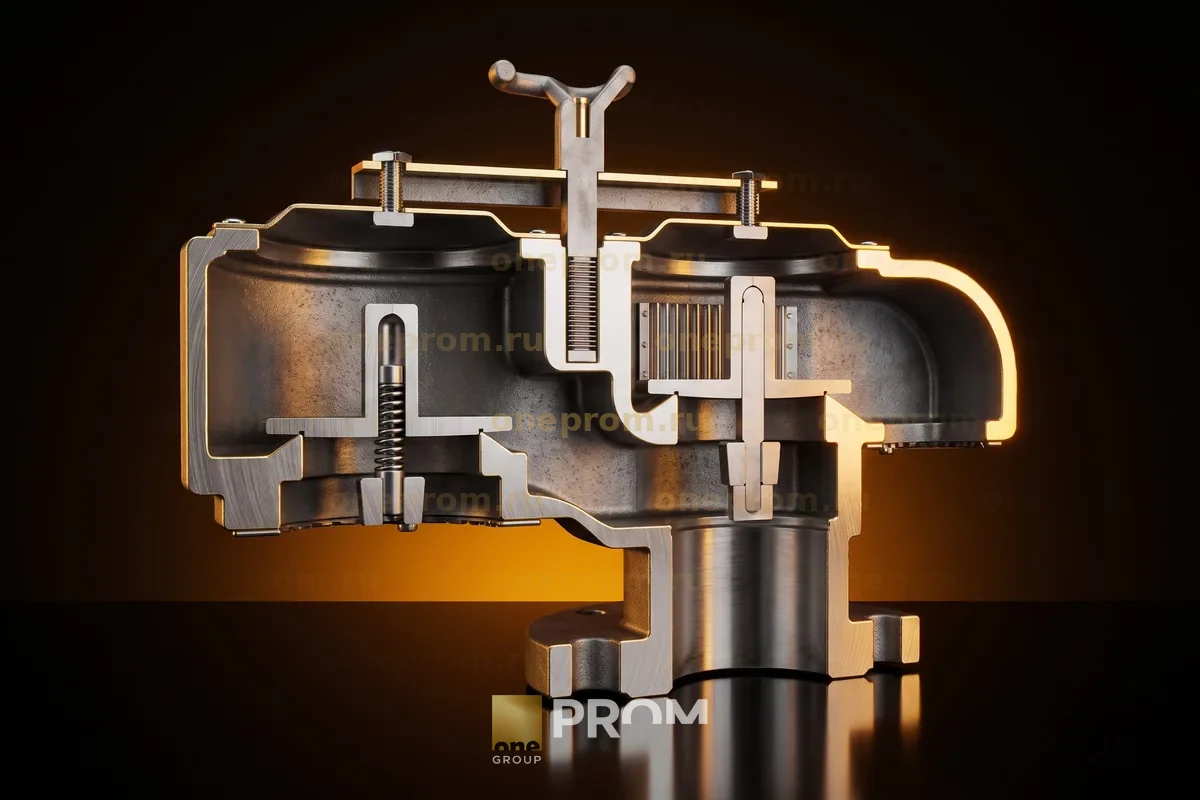
The valve body has two pallets:
- the pressure pallet opens when the internal pressure exceeds the setting and releases vapours;
- the vacuum pallet opens when the pressure drops below the setting and lets air in.
Between operations the valve is closed — this reduces evaporation losses of light fractions. For typical vertical steel tanks, settings are usually about 2 kPa pressure and about 0.25 kPa vacuum. Exact values are taken from the tank passport.
Valve types
| Type | Feature | When to choose |
|---|---|---|
| Mechanical | Weight- or spring-loaded pallets | Non-hazardous products, moderate climate |
| With flame arrester | A built-in element that quenches flame | Petroleum products and other flammable liquids |
| Non-freezing | A design in which pallets do not freeze to their seats | Cold climate, the North, products with humid vapours |
A safety relief valve is also fitted to the tank. It opens at a slightly higher pressure and backs up the breather valve if it fails.
How to choose
The key parameter is flow capacity. The valves on the tank must pass a gas volume no less than the sum of:
- the maximum filling rate — for out-breathing;
- the maximum emptying rate — for in-breathing;
- a margin for thermal breathing from heating and cooling.
If one valve is not enough, several are installed. The nozzle diameter on the roof, the product and the climate are also considered.
We will select breather and safety valves for your tank and filling rate.
Tank equipmentFeatures for the North
In winter, moisture from the vapours condenses and freezes on the pallets — the valve stops opening. This is a common reason tanks collapse under vacuum when emptied in frost. For the North, non-freezing designs are chosen, and valve inspection in frost is included in the maintenance schedule.
Maintenance
- inspect pallets and seats for ice, dirt and corrosion;
- clean the flame arrester element — a clogged element reduces flow capacity;
- check pressure and vacuum settings according to the schedule in the valve passport.
FAQ
What happens if the breather valve freezes?
Why is a flame arrester needed?
Can a valve larger than the nozzle be installed?
How does a breather valve differ from a safety valve?
How often should valves be checked?
Read next
How to Choose a Bellows Expansion Joint: 7 Parameters
Type, diameter, pressure, movement, medium, end connection and cycle life — and what to send the supplier for accurate selection.
Reading time: 6 min
How to Calculate Thermal Expansion of a Pipeline
The ΔL = α·L·Δt formula, coefficients for different materials, a worked example and an online calculator for expansion joint movement.
Reading time: 6 min
Why Bellows Fail: 8 Causes of Expansion Joint Failure
Excessive movement, torsion, supports, corrosion, vibration and installation errors — plus a checklist to avoid them.
Reading time: 7 min
Variable Frequency Drive on a Pump: How Much It Saves
Why power drops with the cube of speed, a worked example and a savings and payback calculator.
Reading time: 6 min