
Draining the settled water and sediment from the vertical tank pit into the discharge pipe. It is supplied complete with a control mechanism.
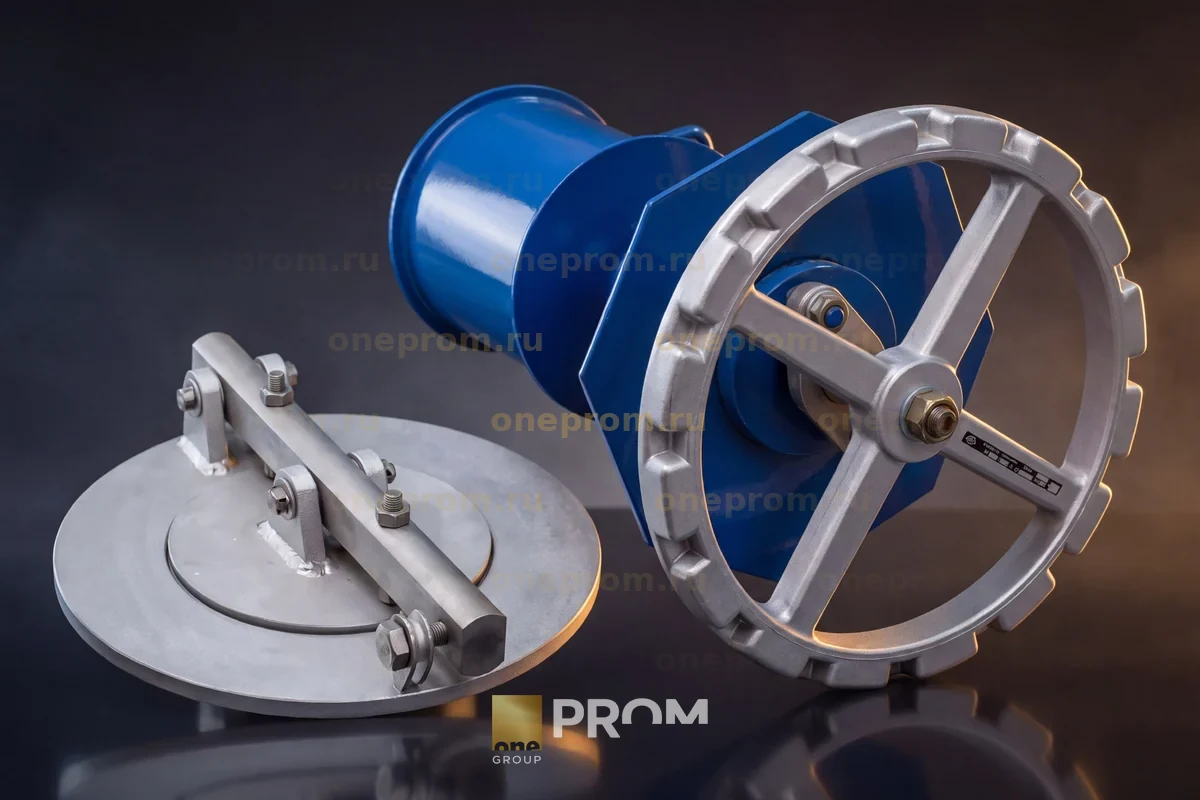
The bottom valve removes from the tank pit what has settled down — settled water and sediment. It is controlled from the outside, from the site, so you do not need to open the tank to drain it. If necessary, the valve can also function as an emergency shut-off element.
It is supplied complete with a control mechanism МУ-1 or МУВ-80, complete with cable, fasteners and straps. The housing is welded to the tank wall and connected to the shaft of the mechanism, which is supported by an additional rack. Installation is performed on new, reconstructed and repaired tanks at the site of operation.
| Type | Bottom valve with control mechanism |
|---|---|
| Purpose | Draining the settled water and sediment from the pit into the discharge pipe |
| Additionally | It can be used as an emergency locking element. |
| Scope of supply | Bottom valve and control mechanism МУ-1 or МУВ-80 complete with cable, fasteners and straps |
| Actuator | Manual, pneumatic or control mechanism |
| Installation | The body is welded to the wall, the shaft of the mechanism rests on an additional rack. |
| Guarantee | 18 months |
| Climatic version | U and UHL, placement category 1 at ГОСТ 15150-69; У1 — from -10 to +40 °C |
| Standard size | Conditional passage DN, mm |
|---|---|
| КМУ-80 | 80 |
| КМУ-100 | 100 |
| КМУ-150 | 150 |
The overall dimensions, weight, working pressure and material design are specified according to the questionnaire.
State the size and parameters, or send a specification — we will make the selection and prepare a quotation.
Request a quoteLeave your contact details — we will select the model and prepare a quotation. We reply within one working day.